

11 seconds of aurora action
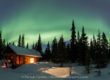
On Wednesday night (2/19/2014) the northern lights were pouring over the night skies in Fairbanks, Alaska. I was not as active as they were, at least not in a serious photographic sense. I had sleep on my mind as following day schedule had its demands. And that is what I did while the aurora danced overhead. However, before I went to bed, I set my camera and tripod up to test a new lens: the Zeiss 25mm f/2.0. From approximately 11:00 p.m. to 2:00 a.m., my camera took 1000 photos at an average of 8-12 seconds each (@ f/2.0.). The orientation of my camera is restricted to the location of my cabin, which is not the optimal direction for aurora displays, but it was fun to see what was happening in the sky while I was sleeping away. Unfortunately, the Zeiss lens was not uniformly sharp at f/2 so I had to return it. It also exhibited some coma in the outer corners. I’m not sure if this was a lens specific issue or not, and will likely try another one soon. I shot in aperture priority mode with a +1.3 exposure compensation dialed in. And I had to wrap my face mask around the back eye piece of my 5D Mark III so the light leak from the back did not effect the camera exposures. I used a basic Canon remote and put it in the lock position. The temps were approximately 5-10 degrees F below zero.


RT @alaskaphoto: Hours of aurora borealis in seconds: http://t.co/OE931zAKrZ
I have been looking at the Zeiss ZF.2 21mm lens and am planning on renting it to see how it does on photographing the Milky Way.
Do you ever use a German Equatorial mount or just a straight tripod & head?
I use a Really Right Stuff tripod and a Kirk Ballhead. I’ve never used an equatorial mount, mainly because I don’t do much time lapse work.
breathtakingly beautiful!!!!!
Very nice – as are all your pics and vids. How did you keep your battery going at those temps for that long?
Thanks.
Brain, the batteries hold up pretty well, I did nothing special and no insulation around the camera.