

Why the Zeiss 21mm Distagon T* lens Rocks for aurora photography
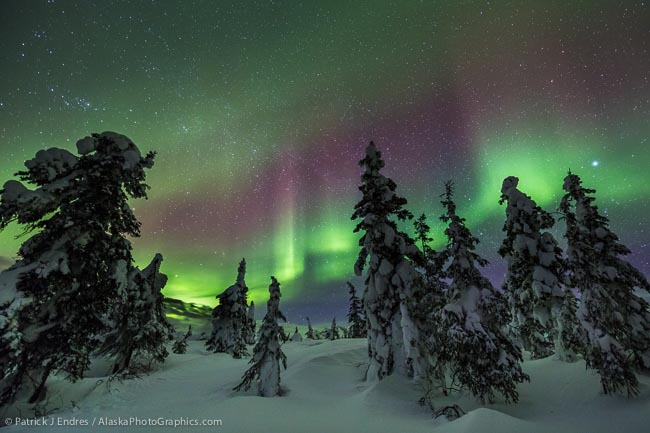
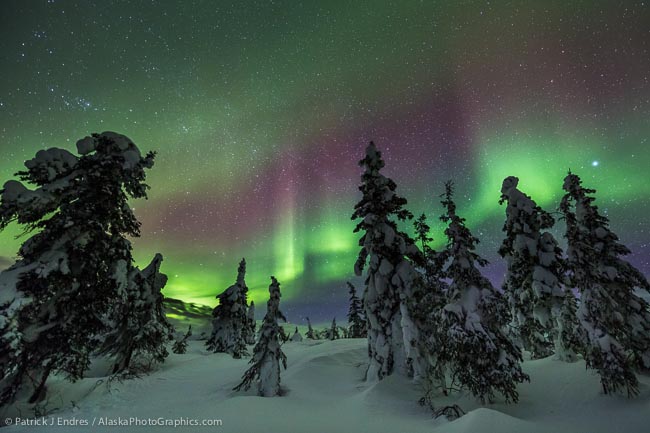
Star filled night sky and aurora. Canon 5D Mark III, Zeiss 21mm f/2.8, 30 secs @ f.2.8, ISO 1600
I’ve always liked Don McLean’s song “Starry, starry night”, about Vincent van Gogh. This scene made me think of it, with the profusion of stars broadcast across the sky. I love the night sky and am so glad I live in a place that offers a light-pollution-free experience of the star-studded theater overhead. It is possible to photograph the aurora borealis in all moon phases, but the sky absent of a moon will render this starry sky look. While out photographing last week, I was amazed at how warm it was for early March. I did not even use hand warmers, which is very rare for me. And by warm, I mean around 10 degrees F. While the March season is fantastic for aurora, the cold weather can hinder your performance. One of the main challenges is getting your lens in critical focus and if this requires the use of live view – which is the case with my Nikkor 14-24 lens mounted on a Canon body – then it requires bare hands for a while to apply tape once focus is secured. If this is not ringing clear to you, I’ve written about it in detail in my recent eBook on How to Photograph the Northern Lights. But this night, I wanted to try out another lens that ranks high for aurora photography in all essential categories: The Zeiss 21mm Distagon T*
- Optical Quality – Extremely sharp
- Ease of use – i.e., Super easy to focus
- Price – Very expensive!
- Speed – f/2.8, Fast enough for aurora
- Wide angle – Expansive at 21mm
Besides the obvious concern for quality – the biggest advantage of this lens is that when you turn the manual focus ring to infinity, it actually is infinity, unlike the other autofocus lenses on the market today. Because of this, there is no pre focus measures that need to be taken and no messing around in the dark trying to use live-view to secure solid, critical focus. For this reason, I’d like to make it a mandatory lens for the participants of my photo tours, but who can require a $2000 lens! It is expensive indeed. It can be rented however, at about $150 for 2 weeks from www.borrowlenses.com. It is available in mounts for Canon and Nikon. If you want a fool-proof, critical focus lens for your next aurora trip, this is it.


Starry, starry night, paint your palette . . .: To to see large photos view the original post.Why the Zeiss 21… http://t.co/A4iKPCXPyx
RT @alaskaphoto: Starry, starry night, paint your palette . . .: Why the Zeiss 21mm Distagon T* lens Rocks f… http://t.co/m4OVXQhrf5
Dianne Porter liked this on Facebook.
Leo Maillet liked this on Facebook.
Amy Stratman liked this on Facebook.
Amy Amick Kovacs liked this on Facebook.
Rachel Huddleston liked this on Facebook.
Jeff Ahl liked this on Facebook.
Deanna Czech Whirley liked this on Facebook.
David Reese liked this on Facebook.
Virginia Wilson liked this on Facebook.
Wendy Cheng liked this on Facebook.
David Roberts liked this on Facebook.
Luke LJ Maillet liked this on Facebook.
Geoffrey Gould liked this on Facebook.
Excellent shot! Where was it taken?
Corey Hester liked this on Facebook.
Patrick, As I understand this lens is manual focus only, but on our Canon cameras, in single shot mode, one still gets a in-focus beep and light? Your thoughts on this?
Jim,
I have not experimented with that to know it’s reliable accuracy, which I would consider important with a non-Canon lens mounted on a Canon. It would be handy if it is accurate for non-infinity focal points in landscape photography in general. For aurora, I’m always racked out to infinity, so it does not matter much in that situation.