

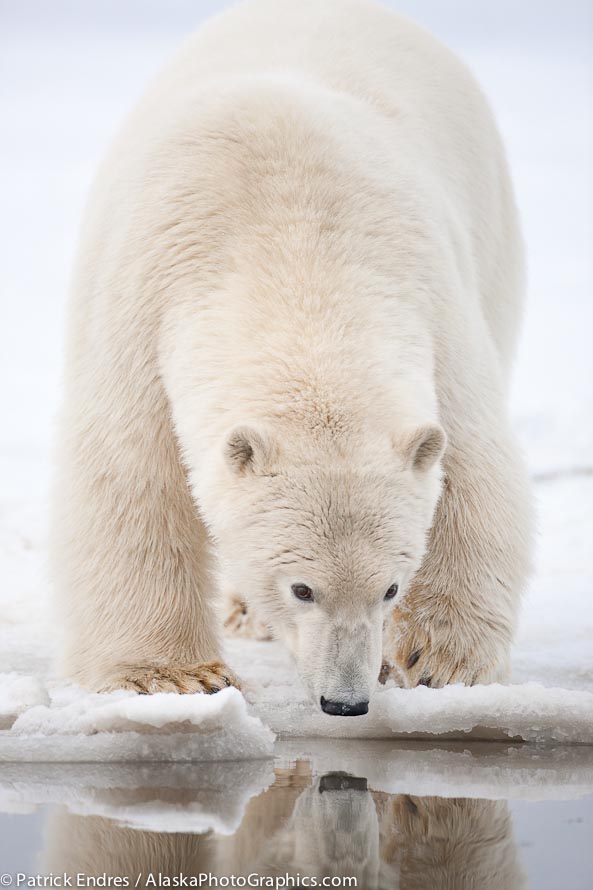
Polar bear reflection along Alaska's arctic coast. Canon 1Ds Mark III, 500mm f/4L IS, 1/800 sec @ f/4.5, ISO 800
A calm day this time of year along Alaska’s typically windy arctic coast is a treat. Such was the case yesterday, at least for a short while. During a photo session with the polar bears, one walked over to the edge of the water and lowered its face to reveal a beautiful reflection. I happened to to have a long lens on my camera, with my focus point set on a specific area. And that is the answer to perhaps your question, and certainly mine: why did I not lower the lens just a little more to capture the full face reflection? Things happen fast and often for a short period of time in wildlife photography. While long lenses have great advantages, I often find that I end up too tight on many subjects. (This is often the case with the 1.3x sensor on the 1D Mark IV and 500mm lens combo. I can’t wait for Canon’s new 1Dx which will finally offer a fast frame rate and buffer at a full sensor size!)
My shooting style is generally in manual mode (when the light is not changing much) with an expose to the right model. I prefer this for the precise exposure control it offers, and it’s consistency presented in post production work. However, there are some drawbacks to manual mode. The main one is that it makes changing exposure values in unexpected situations much slower. For example: in this situation, I was photographing two polar bears fighting and had the shutter speed set to 1/800 second to stop action, resulting in an f/4.5 opening. When I swung over to this scene, I barely had time to quickly focus and shoot, let alone compose much and change exposure. On aperture priority however, it would have been a quick spin of the dial on the back of Canon’s camera to lower the shutter speed and increase the f/stop for greater depth of field. This shot is pretty sharp on the face, but just barely. How many times do we wish we could have an opportunity to reshoot a particular scene!




Beautiful shot, Patrick! I think that the hint of a reflection works really well for this one. Your comments about having only a short time to fire off some shots, and wishing you could revisit a situation again certainly ring true for me.
Hmm. You can’t wait for the 1DX? I am in the camp that is sorely disappointed with Canon. Why? We’ve seen good progression with Canon DSLRs with the 20D, (and that series) and then the 5D, the 5D Mark II, the 1DS Mark II, then 1DS Mark III… all of these cameras in this progression had better resolution. The difference between the 8 MP 20D and the full frame, 21 MP 1DS is incredible. But after over three years of waiting for an update of the 1DS, we are offered a new camera (next year) that only has 18 MP of resolution.
Not what many of us were hoping for. Especially with the progression we’ve seen with the Nikon DX series.
Do we really need 12 FPS? Maybe once in a while that might be nice for certain wildlife situations. But most of what wildlife/landscape people shoot isn’t about 12 FPS. It is about image quality, particularly with landscapes. The idea of having less noise at higher ISOs may have some appeal… but you know what? That is not as important as one might think. Think about it… what kind of shots really ‘work’ best, the ones taken in marginal lighting conditions with little color, or ones taken in decent lighting? Yes, Northern Light photography is taken in the dark- but those long exposures have little noise if using LENR and the proper (noise reduction)tools in the digital darkroom.
I was hoping for the rumored 32 MP resolution in the new camera. That would have been fantastic for landscape photography…
On a positive note- I’ve finally seen your large prints at the Fairbanks Airport- one has to be past the security check point. Well done.
M,
I can agree with many of your points. The perfect camera for me remains elusive. What I have disliked thus far is carrying two 1D bodies, one just for frame rate and buffer. The merger on that level, at this point in the selection, is good news to me. The buffer on the current 1Ds III makes it nearly worthless for any action photography.
I’d be happy with the current 1Ds if the frame rate was increased slightly and the buffer expanded. As for the megapixels on the 1Dx, I would rather see 24MP with 8fps, than the 18MP and 12 fps.
As for landscapes in general, I prefer to not carry the 1Ds. It is way overkill in size and weight for dedicated landscape photography–however, it is rugged and durable. Much of my work in nature photography is a mixture of landscape and wildlife, so I need the crossover flexibility and having just one camera would be beneficial.
I used to shoot the EOS3 in film days, but we are yet to see it’s equivalent in digital. A new full frame 7D would be a good place to start. One camera to rule them all–but not here yet, at least in Canon’s line up.
Pat, thanks for the compliment but a full face reflection would have been perfect – just a tiny bit more!