

Male King Eider duck
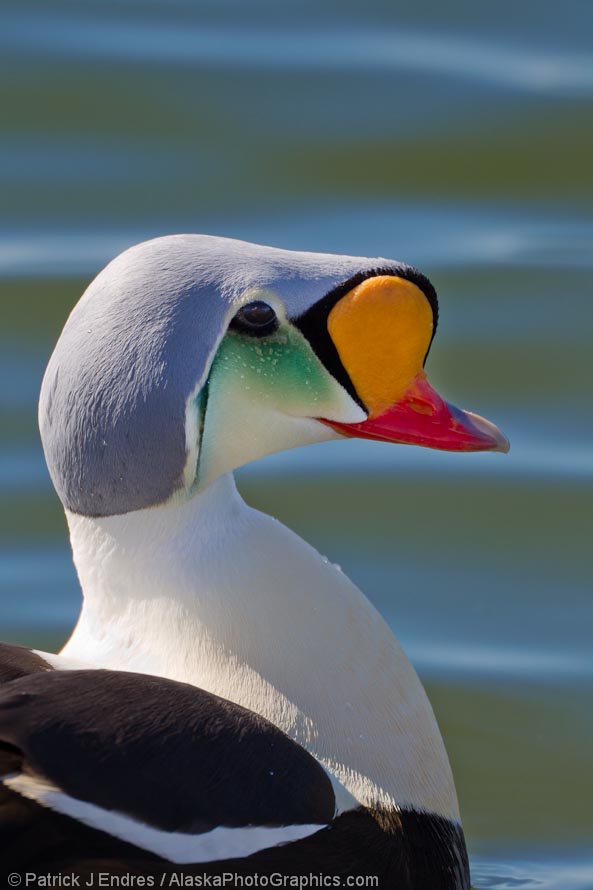
Male king eider duck. Canon 1D Mark IV, 500mm f/4L IS w/2x, 1/320 sec @ f/8, ISO 200.
Earlier in the week I posted a photo of a male king eider duck that I took at midnight in Alaska ‘s arctic, under cloudy skies. In contrast, I wanted to share a photo of the same species, but under completely different lighting conditions. I took this picture at 12 noon, about 12 hours later than the other frame (and not much sleep in between), and while I do not consider that an optimum time for shooting due to hot light and heavy contrast, this worked out o.k. Photographing a subject with white areas in mid day sunlight can be tricky, due to the tendency to blow out the bright highlights. My general approach to a subject in these conditions is to shoot in manual mode, find an exposure that does not overexpose the whites, use as low of an ISO as possible and then be super careful on the focus. The low ISO helps when it comes time to boost the shadows in Lightroom, which are fairly underexposed due to highlight preservation.
I’ve included a screen shot below that shows the initial capture, and the red highlight reveals a tiny bit of blown out area which was recoverable in the RAW post processing.
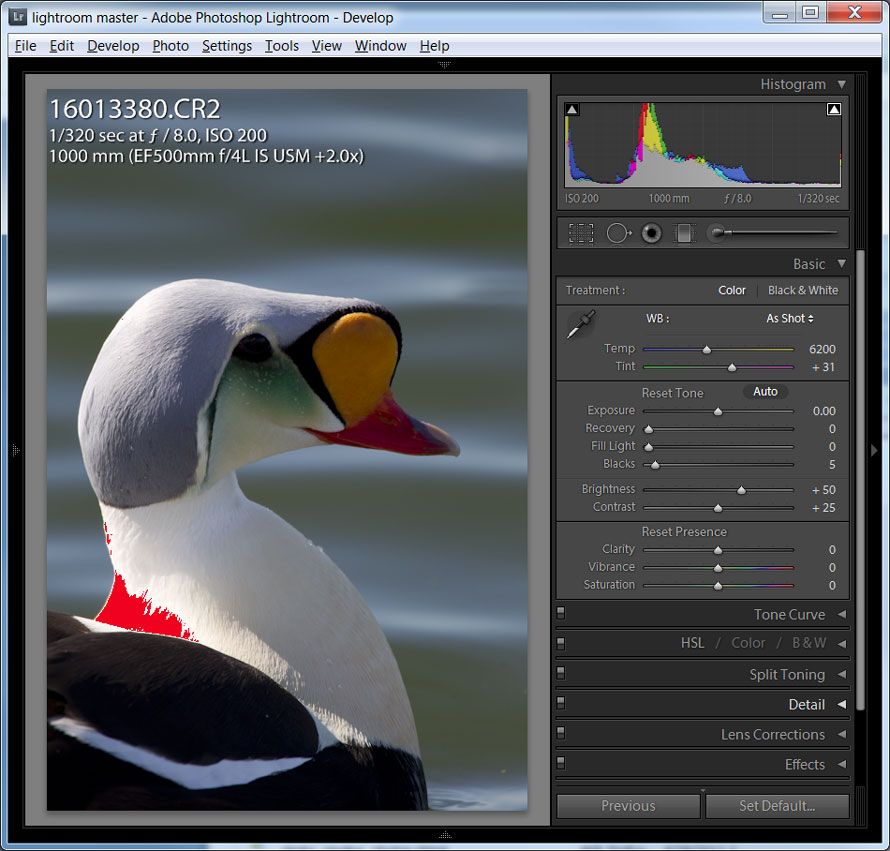
Initial screen capture exposure before corrections. The red spot reve
It might appear like I cranked the saturation in post production, but I really did not. Below is the final processing. I boosted the individual channels of blue and aqua saturation a little bit, but the brightness and fill light brought the color to life in the bird’s face. I also added a brightness brush to the bird’s face to bring in the eye a little bit.
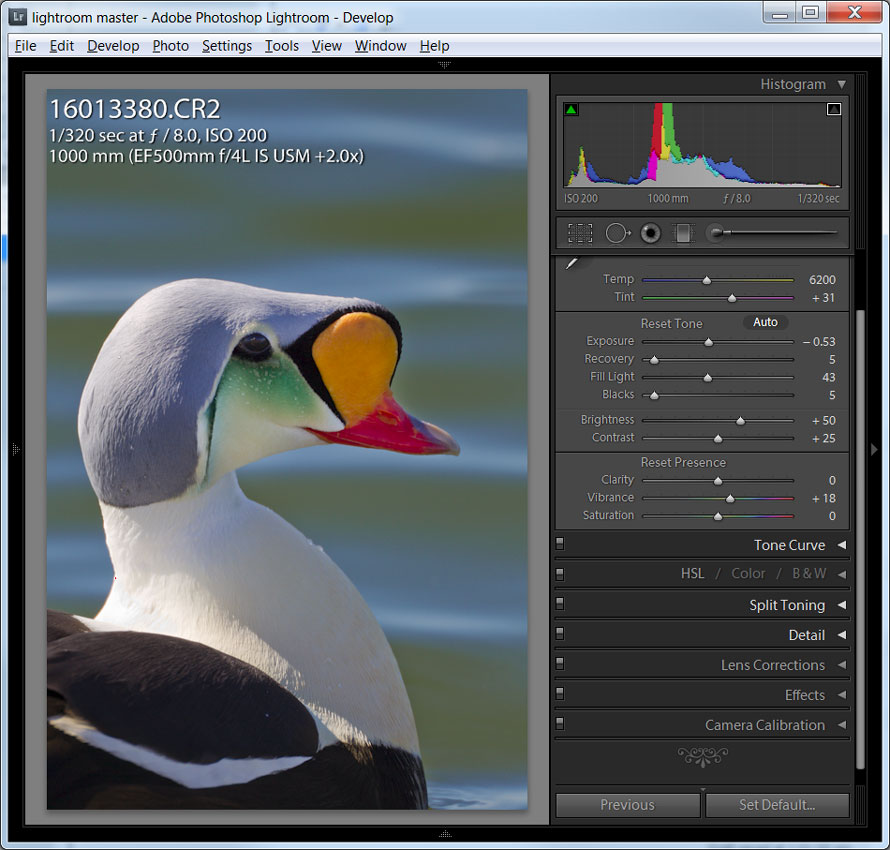
Final adjustments in Lightroom
It is also worth noting that I took this shot with Canon’s new 2x converter on the 500mm, on a 1D Mark IV that equals 1,300mm! It is amazingly sharp, and this tight compression let me make the simplicity of composition and use of positive and negative space that I think makes the image pleasing. It also provides a creamy, blurry background, with a slight pattern.
In addition, the bird raised its neck slightly for a few exposures, which make for a regal posture, as opposed to a more squatty, compressed look. I’ve got a few king eider photos posted on my website, but will have more added soon.




Exquisite!!! 🙂
I usually don’t get results I like with “Recovery”. Somehow, my highlights become “dull” when “recovered”, though I don’t see this effect in your work. I often try lowering “Exposure” while raising “Brightness” to achieve a similar result with regard to recovering blown out areas, but without as much “dulling” of highlights. Who knows what LR is doing, but I’m guessing the effective “Recovery” curve adjustment is sharper and higher than what results from “Exposure/Brightness”.
As always, your work is beautiful and inspirational. Thanks for your processing tips! 🙂
This is fantastic, Patrick! The pose is wonderful, and I love the small drops of water on its face.
@Pat – thanks, I like the waterdroplets too. In some cases, just after a dive, they were big and beautiful, just not close enough for me to get a portrait like this one.
@Tim- I concur with you on recovery. I rarely use it, and often not above 5. In this case, I applied a -42 exposure brush to the hot spot and that restored most of it. But, there is not a lot of detail there anyway. In reality I could have shot another 1/2 stop under but that starts to make quite a boost in the shadows. Although at ISO 200, I think it could have handled it.
He’s georgous. Such beauty and yes he is very regal. Carol
awesome … thanks for your hints on settings and work with the channels … I really should start experimenting around with those more!!!!
@Lois @Carol, Thanks for commenting.