

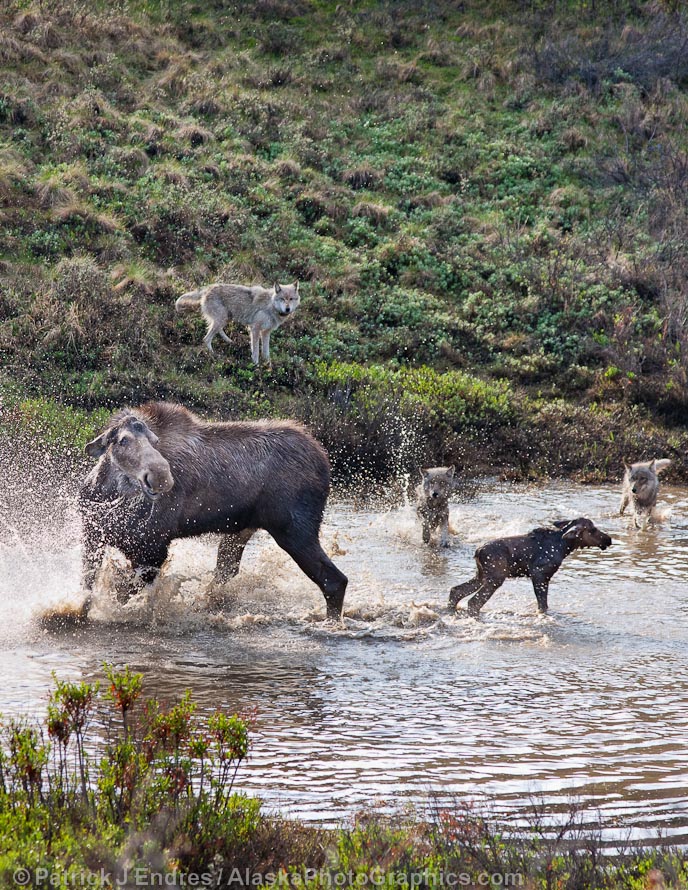
This was a horizontal image cropped to fit the cover of a magazine featuring an article on wildlife management and predator control. A Cow moose defends her newly born calf from the Grant Creek wolf pack in Denali National Park. In the end, the wolves got the baby moose. Canon 1Ds Mark III, 100-400mm f/5.6L IS, (135mm), 1/500 sec @ f/5.6, ISO 800
I recently sold a photo from the most popular series of pictures and subsequent blog post of 2010. The image was chosen for the cover of a small magazine doing an article on the issue of wildlife management and predator control. The subject was the attack of a wolf pack on a moose calf, and the diligent defense of the mother moose. It was an extreme scene to say the least, and although it was very popular on the blog, I do not expect the subject in general to sell much due to its brutal content.
Life as a successful professional nature stock photographer requires the nuanced understanding of the photographic market, along with finding the delicate balance of making a living from the imagery you enjoy shooting. I know my colleagues agree that it is not necessarily the easiest job to undertake, especially in these quickly changing “digital” times, but it is rewarding and filled with opportunities intricately bound with nature itself. To participate in this venue as a form of work is a privilege to me.
To see a scene like the one above is rare, troubling, and awe inspiring. I doubt that I’ll ever see anything like it again, let alone have the chance to document it. What was interesting and equally disturbing to me about people’s response to these images was the wide range of comments they provoked. Disturbing in that it revealed a severe disconnect from nature and the cycle of life and death that occurs daily around us in the natural world. Raw scenes like the one above are often hidden even from those who trek the natural landscape, but all the more from those isolated to an urban-only lifestyle.
There are two books that come to mind when discussing this topic and I recommend both of them.
Ordinary Wolves by Seth Kantner: A novel contextualized in Alaska, addressing the complex issues of land, development, and changes to rural and indigenous culture.
The Last Child in the Woods by Richard Louv: A semi-scholarly discussion about the ways children are becoming increasingly disconnected from nature.
If you are interested you can see the two original posts on the subject here:


You are definitely correct that people are becoming disconnected from nature. Some people responded to your post on this expressing pity for “the cute calf”. Nature doesn’t respect “cute” though. Animals only point in life is survival. Even if it means this helpless calf for lunch. Some people say that we are the same level as animals. However, you need only to look at images like these to see how humans could act towards each other if they adopted that mindset. The most successful and peaceful countries exist when the citizens act respect each other. Nature is full of profound lessons that people miss when they don’t have the opportunity to observe nature!
BTW, (to change the subject) my website is up! See the link in my name. I’d love to hear your honest critique and if you come across any bugs.
Congrats on the sale, Patrick, and incredible series of photos! Have you grappled with the issue of HOW your photos will be used? For instance, if you disagree with wolf control practices, would you sell this image to a magazine endorsing wolf control? A difficult subject to deal with, especially with your income comes exclusively from selling photos. The emotion that this photo evokes makes it a powerful tool, unfortunately as your blog suggests, for people who want to put an end to such “cruelty”.
Eli,
I look forward to checking out your site and will give a little feedback in due time, thanks for sharing your comments.
Milo,
You raise a good question and one that I’ve given some thought. When I sell images directly from my office, I have editorial say so on whether or not I want to support the idea or project by granting permission to use a photo. However, my work is distributed across a number of agencies and portals, and those sales transactions are beyond my immediate control.
In general though, I try to focus on creating imagery and not the editorial commentary behind it. As you can imagine, one image could be used to represent two opposing views. To answer your question directly in the case of this photo, I think I’d be open to both sides of the predator control argument using it. Part of being a photographer is documenting what I see and experience in nature. While the image invokes emotion, it is a common event, even if we seldom see it. How someone interprets that event will ultimately and hopefully be determined by a thoughtful review of pertinent data, and human observation. This subject is certainly more complex than this little summary, but its a slant on my take. Thanks for engaging.
For our family, nature offers healing from living in a materialistic consumer driven neighborhood, where bloated basements and empty souls are coveted. We run toward the rituals of the natural world in our nature friendly backyard often. For us, it is not only a leisure pastime but a life’s necessity. As a family we are battling, and winning, against the insidious nature deficit disorder.
And whatever the demographics of any publication, any editor would be a fool not to publish this image in their magazine – readership would jump tenfold!
Steve,
We sing in the same choir when the song of nature is on the page. It is a necessity. And one which grows in depth and value to the degree it is embraced. Thanks for sharing your comments.
Hi Patrick,
While looking for a link to view a film on Isle Royale wolves I saw this video on Youtube of this attack-http://youtu.be/tMC7aZNXnL8 I’m wondering if it’s your shutter I’m hearing clicking feverishly-what a great experience