

The pursuit of northern lights photography led me to the purchase of Canon’s 24mm 1.4L, and the following updated version II of the same lens. My comments are derived from experience with this lens in the field and are not a comprehensive review by any measure. Here is what Canon has to say about this lens.
“Canon’s newest fixed length L-series lens, the EF 24mm f/1.4L II USM, incorporates the newest in Canon lens technology for spectacular sharpness and impressive performance at all settings. It features two high-precision, large-diameter aspherical lenses for sharpness across the sensor, even in peripheral areas of full-frame sensors. Lens elements have a newly-designed anti-reflective SWC (Sub Wavelength Coating) that departs from conventional coatings by using an extremely fine structure that minimizes ghosting and flaring across the lens surface, regardless of the angle with which light enters or exits. It also features two UD lens elements to minimize chromatic aberrations, incorporates rear-focusing, ultrasonic, quiet and high-speed AF with full-time manual override. A circular aperture provides beautiful out-of-focus detail and offers legendary dust- and water-resistant L-series construction using only lead-free glass”
This paragraph is enough to get anyone excited about the lens. But certain aspects of aurora photography put the lens to test. Because I use it exclusively at f/1.4, I’m not much interested in how it performs at other f/stops.
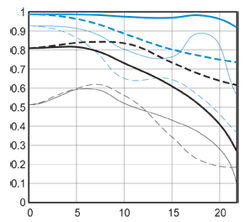
MTF chart for Canon 24mm f/1.4L II.
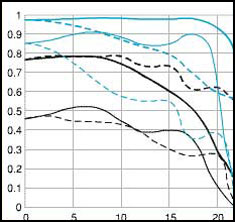
MTF chart of the old 24mm f/1.4L
Just a reminder when looking at the MTF chart: the left end of each chart represents the center of the lens and right represents the outer edge. It is clear that the new lens comes in pretty sharp at f/8 (the blue line). But the black lines are what interest me since they represent the lens performance wide open, in this case f/1.4. The thick lines (solid and dotted) represent contrast, the thin lines (both solid and dotted) represent resolution (or sharpness). I’m trying to simplify this, since there is certainly more to say about an MTF chart (see more at luminious-landscape).
You can see that the black lines fall off considerably towards the outer region of the lens, although they are an improvement over the previous version. Keep this in mind when looking at the images below, since the enlargement areas are in this outer range of the lens–more specifically the upper right corner of the frame in this case. Bright stars in general, but much more specifically in the outer region of the glass, grow some sizable wings and look like flying birds. The darker the night, the brighter the stars, and the more accentuated this appears. Additionally, a dim aurora generates a longer exposure, burning in more of the stars and further accentuating this artifact. This image was taken on a moonless night with a very dim aurora and represents the worst scenario for a good example. It was taken with Canon 5D Mark II, 30 seconds @ f/1.4, ISO 1600
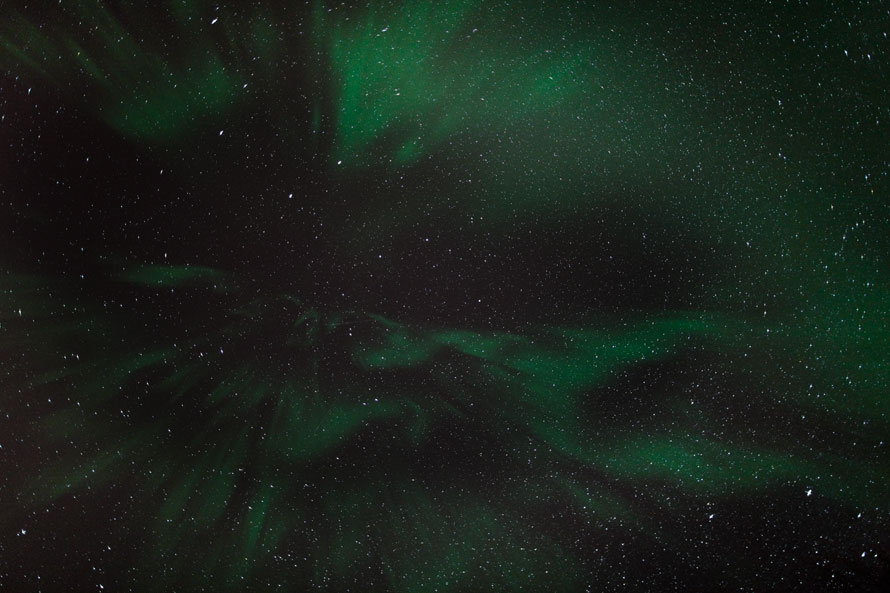
Full frame shot of aurora
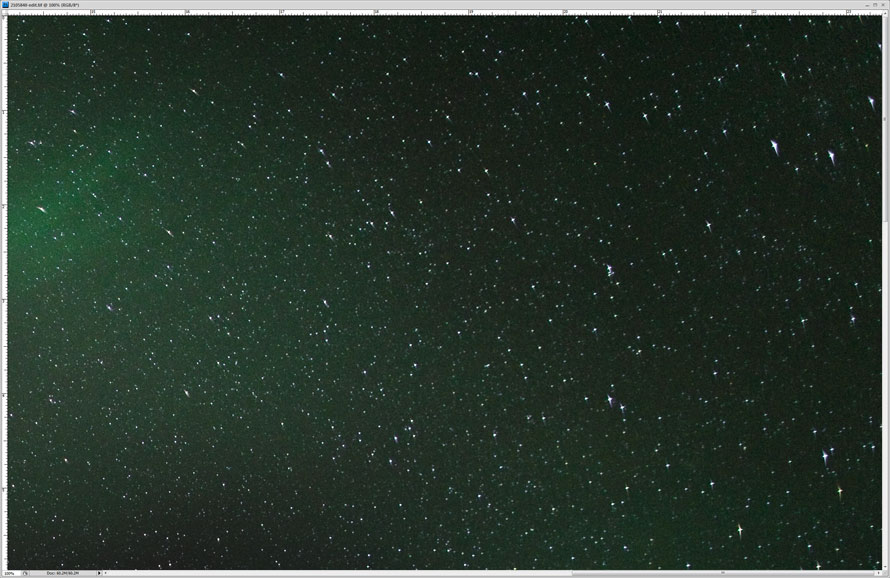
100% view of upper right corner.
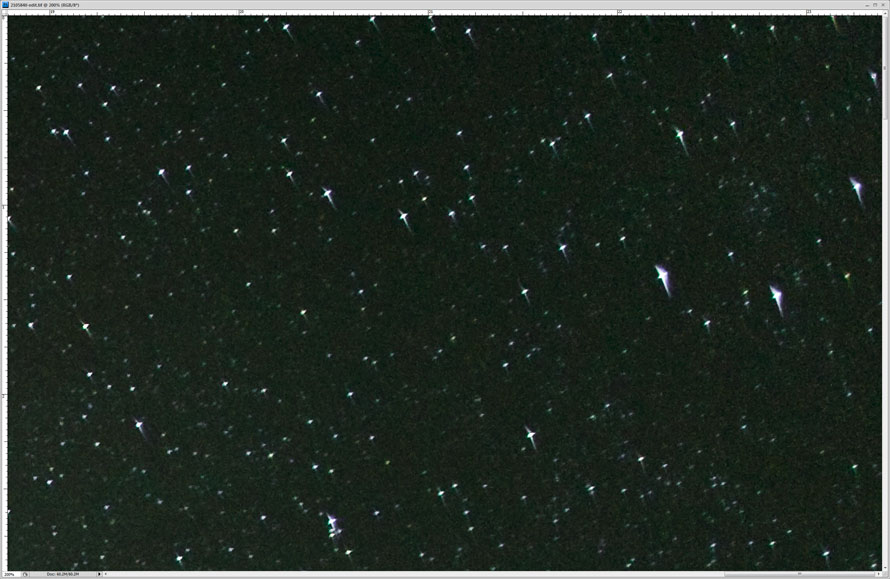
200% view of upper right corner. The wings on the stars are pretty evident.
Some may find this unacceptable. The problem is, there are no other f/1.4L lenses out there to choose from. I’ve went back and forth on whether I think I can let something like this slide, which would normally be totally unacceptable from the rigid criterion I generally use in judging landscape imagery. But shooting the northern lights is a different subject all together. Would I like a clean image all the way to the corners, of course.
Where the f/1.4 really shines is the obvious speed it delivers. A 30 second exposure at f1.4 of the aurora on a dark night is a 2 minute exposure with an f/2.8 lens. That is a huge time disparity, and the two captures can look very different–from the ability to capture aurora shapes to minimizing star trails. It is that ability that keeps this lens in my line-up. Additionally, I could capture 4 frames to 1 in this same situation, producing more images. I generally photograph with two bodies. One has the 16-35mm 2.8L and one with the 24mm f/1.4L II. Currently, I don’t shoot aurora higher than 1600 ISO, but that could change soon, and the ability to shoot at 3200 or 6400 ISO, could offer the option to use other lenses.
What about focus? I sent my lens off to Canon (with the body) to be calibrated, which they did on both the lens and the camera, in vertical and horizontal positioning. But, I still don’t trust it. From now on, my method of achieving critical focus is to use Live View and a loupe on the back of the LCD, just to be safe (see my previous post on that subject). There is too much effort that goes into shooting the aurora to end up with soft images. Additionally, it is always a good idea to check images occasionally by zooming in on the back of the LCD to confirm uniform sharpness.
So in summary:
- Is the new lens better than the old? Yes, from the review of my files it appears sharper.
- Is the new lens worth twice as much money as the old one? Probably. It depends on what you seek to achieve. It is to me because I’ll take the slightest bit of improvement.
- Is the new lens perfect? No
With the aurora, the drama of the scene generally wins out over a super technical review of the corners of the image. At least for most people. They are wowed by the scene much more than they are dissed by oddly shaped artifacts in the stars. So it is a compromise of sorts, and one I’m willing to accept right now anyway.



Have you tried any shots at slightly narrower apertures (i.e. 1.8, 2.0, 2.8)? How do you think that this lens would compare with the 16-35mm II at comparable focal lengths and apertures? I have neither lens and have been considering one or the other for awhile. I have held off for a number of reasons – low solar activity and high cost being the two big ones. Thanks for the real-world review! 🙂
Jeff,
Next on my list is to compare the lens at varying apertures. Although, as I mentioned, my real interest in the lens is for the 1.4 opening. I think the 16-35 II is a great lens, and I would tend to recommend that over the 24mm 1.4, if you have the option of one or the other. True, it is slower, but it also is much wider, which gives you flexibility in capturing more sky and thus more aurora shape and activity. I use that lens often, and it is quite sharp. If you are feeling rich, bloat that shopping cart and get both.
Hey Patrick,
What do the stars in the center of frame look like? Do they have little “wings” as well? I ask because you example looks like the camera shook (maybe from wind). I used to get similar “winged” stars on my old astro mount and added a heavier counter-weight below the center axis solved the problem. Mark had a similar experience as well and he solved it with a heavier tripod and mount.
Randy,
I take your sharp perceptions to heart, however in this case, I’ve pretty much ruled out shake as a contributing factor. The center is pretty sharp, although it would have been a bit more comprehensive had I shown screen grabs from that area as well. This winged phenomenon is exclusive to this lens in my collection save a slightly less, but similar problem on a Sigma 20mm f/1.8 that I tried a while back. I’ve reviewed some files from the old 24mm f/1.4L and they present a similar dynamic. It appears to be a brightness flare in conjunction with a lack of sharpness in the sagital lines. However, I am no optical engineer and that hat is rightly worn by another. The consistent outer star blur seems to confirm this, in particular, when I have other regions of the image in sharp focus.
From what I read, all the fast wide angle lenses suffer from coma (“winged phenomenon”) wide open. By f2.8, the problem is gone, and the 24/1.4 @ 2.8 is considerably sharper than the 16-35 @ 2.8, but 2.8 would require ISO 6400. So it’s all compromises…
QT,
Thanks for your input. I’ve read some of your lens reviews and appreciate your efforts there. It is indeed a compromise to balance sharpness and optical excellence with very wide apertures. Unfortunately, Canon’s current lead cameras just don’t quite cut it at 6400 ISO, but that may be getting better in the future.
Patrick,
I ordered the lens a week ago mainly for aurora and star photography, but the excessive coma issues are giving me second thoughts. Maybe I should think of the coma of this lens more as a feature than of a bug. I thought about buying the Rokinon 24/1.4 but I need a lens that is sealed against the elements. Funny you mentioned Canon’s weak high-ISO performance in 2010, now they’re selling the 6D, which I own, and I can vouch for its noise-free high-ISO performance.
Just bought this lens couple of weeks ago, mainly for auroras and star photography but also for landscapes and etc.It seems a superb lens, although I still need to get all the juice from it, still new to me. However the winged stars in the corners is annoying, a price to pay at 1.4. Any known method to eliminate it in post process?
P.S.: What a show during the 17th!!! Here in Finland there was huge activity since 8 in the morning but obviously impossible to spot. Was praying for it to last until it got dark and IT lasted! 🙂 I was once more jealous from the NA inhabitants, but finally it also was great here. Corona and etc displays for longer than 4 h. Then I was just freezing and shaking and we left home. it only was -20C I dont know what you guys do in Alaska when is -30 😀
Cheers from Joensuu, Finland!
Victor
Victor,
The winged artifacts are called comatic aberration and I do not know a way to get rid of them. It is a common phenomenon to f/1.4 lenses. However, since this blog entry, I have purchased a Rokinon f/1.4 24mm, which exhibits less coma. There are compromises using these fast lenses.