

Staying Warm During Cold Weather Photography
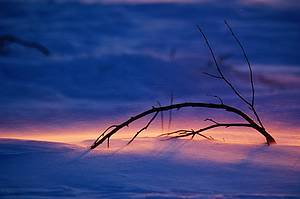
Pink sunset backlights blowing snow on the tundra. © Patrick J. Endres
To enjoy photographing in cold-weather conditions you a dress regime that keeps you warm enough to function and enjoy the experience. Alaska’s winter offers a unique angle of light, soft pastel colors, a serene simplicity, and sometimes extremely cold temperatures in the Interior and Arctic regions. Here are some tips to help you stay comfortable and functional while photographing in the cold.
Staying Warm
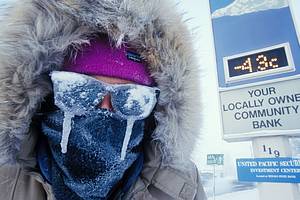
Sometimes you can convince your friends to do crazy things for a photo. I used a spray bottle of water to make the icicles on these sunglasses. © Patrick J. Endres
There are two main ways to stay warm:
- Internal Heat: Generating heat through exertion and retaining it with external insulation and clothing.
- External Heat: Absorbing heat from external sources like a wood stove, chemical hand warmers, or hot fluids.
Sometimes, just adding extra insulation isn’t enough, and a supplemental heat is necessary. Personally, I’ve found a combination of both methods works best. Over the years, I’ve developed a system that keeps me reasonably warm even though I seem more prone to cold hands and feet than others.
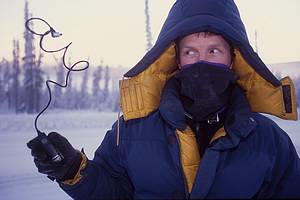
I favor thick-down parkas for the chilly winter conditions. Note that the electronic shutter release, usually soft in warm temperatures, is rigid at 40 below zero. © Hugh Rose
Layer Essentials
For Alaska’s sub-zero temperatures–when standing still waiting perfect lighting or for the northern lights to appear–I prioritize insulation over layering. While layering is critical when engaged in activities that generate varying amounts of body heat, the deep cold conditions require loft and warmth, which down garments provide best.
I start with a merino wool base layer (soft and moisture-wicking) and avoid cotton altogether. Over this, I wear a mid-weight shirt with a collar to protect my neck, a down sweater, and finally, a hooded down parka. For my legs, I use a similar base layer with insulated bib overalls. It’s important to avoid anything tight-fitting, as it restricts circulation and reduces warmth.
Hat and Face Mask
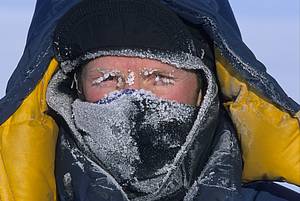
A face mask is a better option than this neck muffler due to the build up of condensation and frost from breathing. © Patrick J. Endres
Nothing beats my beaver hat for warmth, though a well-insulated hood or a smaller wool or fleece hat may suffice. I also use a face mask or neck muffler for additional protection. My merino wool neck muffler is soft, warm, and comfortable but tends to collect frost from breath condensation.
For longer outings, I prefer a lightweight face mask with breathing holes and a nose guard. This minimizes frost buildup and dries quickly, offering a practical alternative to heavier materials like neoprene.
Footwear
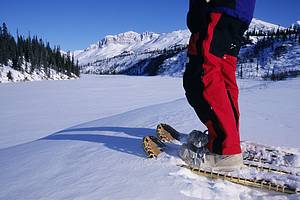
Bunny boots are a tried and true, although heavy, warm winter boot choice. © Patrick J. Endres
Warm boots are critical, but many are overrated in their insulation claims. Choose boots with enough room to wiggle your toes, even with thick socks, as tight footwear can reduce warmth. Look for boots with a substantially insulated soles and consider adding interior felt insoles for extra insulation. They can also be easily removed to dry in between outings.
Military-style “Bunny boots” are a favorite in Alaska—heavy and unattractive but exceptionally warm. Cabela’s Trans-Alaska boots are well insulated and waterproof, I get a size or two larger so they will accommodate a felt liner and thicker socks. Removable liners are particularly useful for drying at the end of the day.
Gloves and Mittens
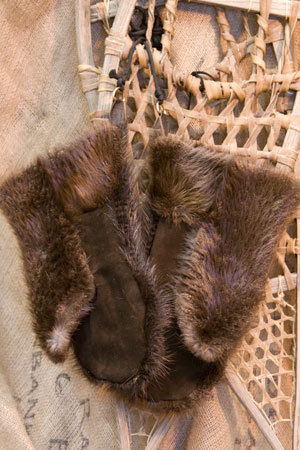
Beaver mitts are large enough to fit a glove inside and have a soft enough leather pad to let me operate my camera. © Patrick J. Endres
Keeping hands warm is my biggest challenge. My system includes thin, loose-fitting wool gloves as a base layer. For temperatures below -10°F, I add medium-weight fleece gloves, both of which fit inside large, fur-lined mittens. Beaver mittens, with their supple leather palms, are ideal because they allow me to operate my camera without removing them.
For added warmth, I place chemical hand warmers inside the mittens. When I need extra dexterity, I briefly remove the mittens and warm my hands again afterward. In extreme cases, I use the mountaineer’s trick of “windmilling” swinging my arms to force blood into my hands. It’s not glamorous, but it works.
Equipment Considerations
Many of today’s current digital cameras are impressively durable in extreme cold, functioning even at -30°F to -40°F. While the LCD screen slows down, it remains operational. Batteries, however, drain quickly. I keep spares in my parka and rotate them as needed. SanDisk Extreme cards also perform reliably in freezing conditions.
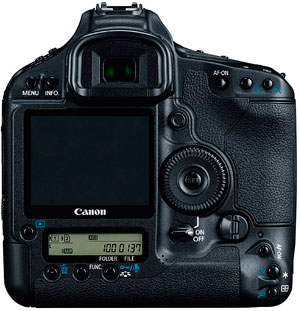
The wheel on the back of the Canon cameras is a perfect design element for operating the camera with mitts or gloves. It is easy to turn with the thumb or finger and thereby control exposure settings.
To avoid frostbite, I’ve padded any metal parts of my camera that touch my face with moleskin. Additionally, if I anticipate long waits, I remove the battery and flash card, storing them in my parka pocket while leaving the camera on the tripod.
Thanks so much for this article. I just found your site today… love it.. thanks for all you do. Looking forward to going all through your website.
Thanks again.
You are very welcome!
want to see warm gloves for very cold hunting.
Thanks for this very helpful article. I’m looking forward to doing some aurora photography around Fairbanks next year, and this will help me prepare for the experience.
You are very welcome Alan.
Hi Patrick, I’m wondering about an equipment issue after photographing in extreme cold weather. I’m not new to Alaska, but new to extreme cold photography. I live in the arctic and have been seeing -40 to -60 temperatures most of the nights I head out to photograph the Aurora. Upon returning back inside my camera becomes glazed over with a tiny frost like look, it usually takes at least an hour to go away. Sometimes if I leave it in the arctic entry, or a garage hallway it will warm a little slower, but have the same effect. Have you experienced this? Is it bad for the camera? If the outside looks like that, what is happening inside? Thanks for the help. ~Sam
Samuel,
When it is that cold, its a good idea to either put your camera in a zipped, camera pack, or airtight ziplock back before taking from cold to warm. Then let it slowly come up to room temperature before oening it. That will prevent internal and external condensation.
Patrick,
I happened across your website when we heard a weather report for Alaska that was -49 degrees. I wondered how people survive that kind of temperatures and found your beautiful photos. I really enjoyed the website and will be ordering the calendar. My daughter, Caitlin, is a photography student and I will forward this website address to her, so that she too can enjoy the beauty of your work. It must be fascinating to live there.
Sincerely,
Marlene McAuley
Thank you Marlene,
Glad you enjoyed the photos. Alaska is an extreme land, and I very much enjoy that element of life in the north.
I’m glad I found your site. I just read your post on photographing Northern Lights and will be in search of polar bears this October and hope to be lucky enough to see and and photograph the lights as well. Thanks so much
Patrick. Thanks for the good advice on clothing. Am going to Alaska in March to photograph the aurora. The parkas all seem to be described by down fill weight rather than outside tenperature. What weight fill would you recommend for that time of year?
Hello Patrick, Greetings from the UK. I have very much enjoyed looking at your site. Yes, working well below zero poses some interesting issues in photography and clothing! I use both digital and pinhole. Not a problem with either – except in the complete winter dark! I have been taking pictures in Iceland and Spitzbergen and I plan to come to Alaska in the summer – where my worry is more likely to be flying things that bite. My interest is energy within the landscape.
I’ve not been to Alaska before but I am interested in taking shots of pipelines or the oil industry. (Have a look at my pictures of geo-thermal plants in Iceland and coal in the Norwegian arctic. As you will see I work in a generally non-documentary style.)
My main concern is that I am in absolute ignorance of access conditions and my worry is that post 9/11, and private land issues, access might be difficulty. Also I have read that there are no tours of the oil installations. Is this so? Any advice would be most welcome.
Best wishes
Gina Glover
Gina,
You can photograph the pipeline along its route, but access to the oil fields is restricted. There are tours that take you into during the summer, but there is little photography that can done from the van’s with non-opening windows.
Hi
Thanks for the helpful info. I normally shoot on hot exotic locations. In shooting in Lapland in December where temp averages -9 to -14c. Do I need to worry about Canon freezing or misting up. Is it best to keep camera warm or cold
Alan, you should not need to worry about the camera. Watch the lens for frost if you are in a moist environment. Going from warm to cold is no problem, going from cold to warm will create condensation.
You have taken the time to write a very informative and useful article full of valuable tips based on personal experiences. Thank you
Thanks for the article,Im off to harbin to take pics of the Ice City. Bought some merino wool jumpers a ski pants and long johns.Sorel boots got from USA set me back$144 plenty room inside.Have also took eyelids out the top 3 and replaced with the speed ones as to do the boot up faster. Also use canon MKIII but will only use the 16-35 lens and the 70- 200 as the are water resistant other zooms that adjust in and out i feel are a no no!! Thanks for the tips hope, Im prepared have 4 batteries as well.
Thank you for writing so extensively about your personal experience staying warm in such a cold climate. This beats the ads for warm winter photography gloves that have always failed for me. I have a pile of them to prove it. Now please tell me where to find beaver mitts and a beaver hat. Best wishes!
Hi Sally,
My contact for that is Christine McHoes, here is a link to her facebook page. If you get the mitts, tell her you want the kind that Patrick uses.
What about camera parkas? Have you ever used them, and if so, what do you think about them? I’m considering the purchase of one – but they are pretty costly, in my opinion.
Rebecca, I have never used a camera parka, as I’ve never really had a camera freeze up. If it is that cold, then I usually fail before the camera does.
Thanks for the info. They seem rather expensive anyway.