

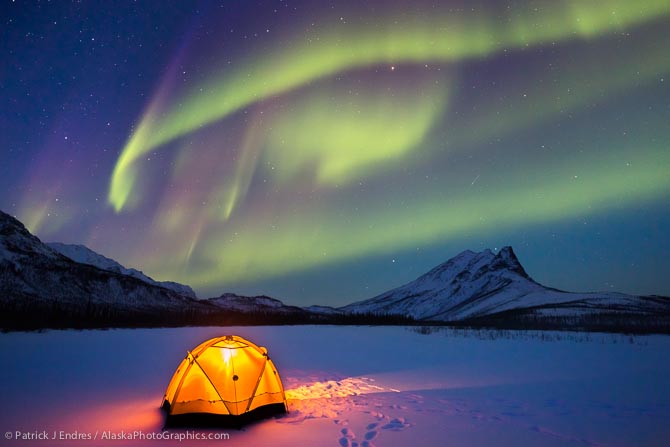
Aurora over winter camp in the Brooks Range, Alaska. Canon 5D Mark III, Nikkor 14-24mm f/2.8, 10 sec @ f/2.8, ISO 1600.
This is another photo from my recent trip into the Brooks Range to photograph the last show of aurora before summer. I was using a wireless remote to attempt some self portrait work, but the long time in the subzero temps caused some problems and it quite working. So I used a regular remote in the lock mode and let it take consecutive pictures. I’m in the tent, but in this frame, I’m a little blurry. I do have some where I’m more distinguishable, but the aurora is less dramatic in those.
My Canon 5D Mark III Rant
I’m including this picture to vent a major frustration that I have found with the Canon 5D Mark III. It has to do with my long time shooting style of the aurora, which is to use aperture priority with some compensation dialed in. With this method, the camera can make adjustments based on the intensity of the aurora. But… with the 5D Mark III, light leaks in through the viewfinder and influences the exposure values. This means that you have to cover the viewfinder when creating an exposure – which is a total pain. I have never had a problem like this with any of Canon’s other 1D or 5D series cameras, and I’ve owned them all. What did you do Canon? Yes of course, there are some work arounds for this, but if you have ever spent extensive time in cold weather at night, photographing the aurora, none of them are easy or efficient.


While not up to par with your Canon 5D, my Nikon D5100 came with an insert to go over the viewfinder (which I almost threw away). I did put it in as we spent 6 weeks in Churchill (as volunteers) taking a lot of aurora pics. One thing we quickly found out was that you didn’t want to have to have anything go wrong or require much tweaking in the cold of Feb/Mar up there. Have been enjoying your blog and certainly your pics.
Brian, Yeah, those little plastic covers are worthless since the get rock hard in the cold and you can’t effectively handle them with mittens or gloves on. I tried a taped flap, but that gets rock hard in the cold also.
Sounds like one of those wireless remotes with live view you can use with an iphone is in order
Surprised the camera doesn’t have a built-in eyepiece shutter, that you can close for just such types of shooting. Something my older Minolta and Sony cameras have had for a long time. 🙂 I guess it’s really only a problem when you want to do remote shooting, such as you were doing here, and when light values are changing thus requiring different exposure settings.
I think we all wonder at times why “our” respective camera manufacturers do some of the stupid things they do (or at least what we consider stupid things). They all do it. 🙁
Ditto Mark, Canon loves to dumb down their semi-pro models.
I found the same problem with my 5D3 down here at Denali Park after trying your Av technique last weekend. I have normally used Manual and the eye piece cover, but wanted to try your method. My lesson learned is to try one small procedure change at a time. I had a 7D shooting as well and was way behind the 8 ball. Enjoyed you new book and appreciate your blog posts.
Rick, in manual mode you don’t need the view finder cover at all, but I often shoot multiple camera’s and leave one unattended for a period of time, still shooting. While any variation of a view finder cover will work, it is still a major pain to mess with it every time you want to look and recompose. I’ll be exploring what actually changed in the camera design to introduce this into the Mark III series.
I like the variation of colors in the this scene. They offer great contrasts with the greens, blues, and oranges. Nice winter scene.