

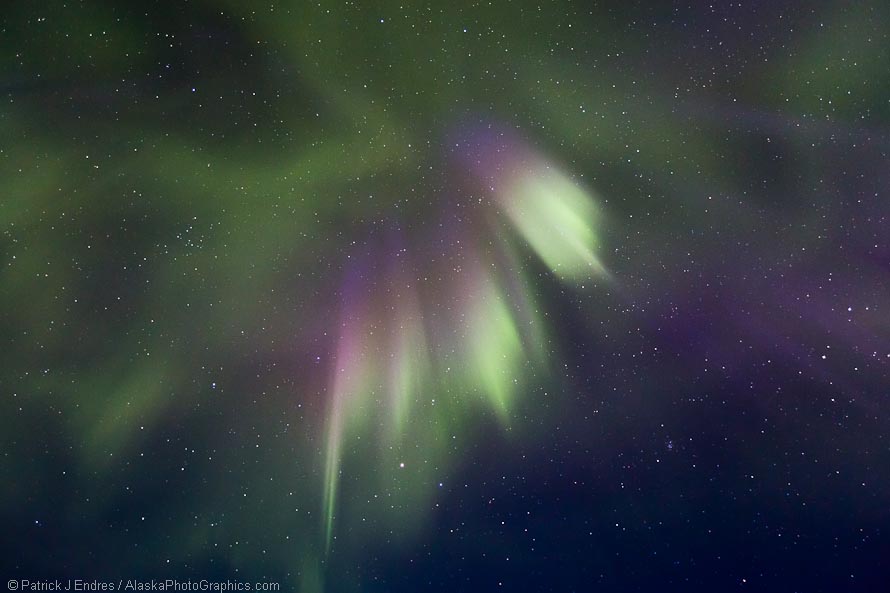
Purple and green bands of aurora borealis in the star filled sky of interior Alaska. Canon 5D Mark III, 16-35mm f/2.8L, 10 sec @ f/2.8, ISO 1600
The tide of light has shifted in Fairbanks, Alaska and darkness is getting hard to find in the night sky. More specifically, I heard a sandhill crane yesterday morning, the first of the year. To me, that is the official, inaugurating tune of springtime. While it is still possible to get a snowfall or two, it is unlikely, and the sun is pushing out some serious heat and light. So three cheers to aurora photography, that won’t be happening until late August or early September, after a robust summer. It is time to get psyched up for the infusion of light and get plans in order to trek Alaska’s tremendous landscape. I’ve got a few trips that are scheduled, but weather will dictate the final details of many more to follow.


Hi Patrick…I’m probably going to embarrass myself with these questions, but I think you’re my best aurora source so I’ll go ahead. 🙂 I’m really taken with aurora photography. I live in Northwestern Lower Michigan (Northport) and get some opportunities for auroras too, but not so spectacularly or as frequently. When I look at your aurora pix, the auroras are mostly green, but sometimes red or purple. Is that the way they look to the native eye in Alaska? The few times I’ve seen them here, they look like a brighter, almost white-like swath in the sky. Last night the Kp was nearly 6 and I went out and saw the same white-like swath in the sky. I’m pretty sure I was seeing aurora activity, and it was huge. I was waiting for the green to appear and didn’t shoot anything. My photography buddy that I shoot with took a couple shots of the white swath over Lake Michigan, and upon replay, she didn’t see anything either on her camera, except the lighter sky and stars. But when she got home and loaded her pix into Lightroom, and did an AUTO fix on the exposure, she had this gorgeous green aurora plus reflection into Lake Michigan. So I’m wondering if auroras do show green to the native eye or whether that only happens with the long exposure, or in post-processing.
Karen, a Canon 7D shooter
P.S. Thanks for your great article on photographing the northern lights. There a lot to it, but every time I go out, I learn something new.
Karen,
The full answer to your question is lengthy, but in summary: Remember the aurora that you capture on film/digital is not what your eye sees since it is gathering data for a continuous 10-30 seconds, and therefore records not the split second that your eye sees, but a continuum of time. So, often what you get on film is different that what the eye sees. The sensor is also a little more sensitive to certain colors than the eye also. I do see the white milkish aurora sometimes, and it is definitely less dramatic. Post production can enhance contrast and color, making the shapes more definitive, which is what the auto button for your friend. So in summary, it is post production, the length of exposure, and the aurora brightness/color (not always visible to the eye) that all make a difference.
Hi Patrick,
Sweet Aurora image, I have a few little howlers (wolf pups)that I’ve recently taken (took more today of a young black female 2weeks old) that if you’re interested could make some nice composite images-https://farm8.staticflickr.com/7046/6935485166_35f2cfe97f_b.jpg & https://farm6.staticflickr.com/5350/7081640739_3d90e681c2_b.jpg Let me know what ya think, gotta start tagging these new pics
Shalom & good shooting