

Polar bear cub, late evening light.
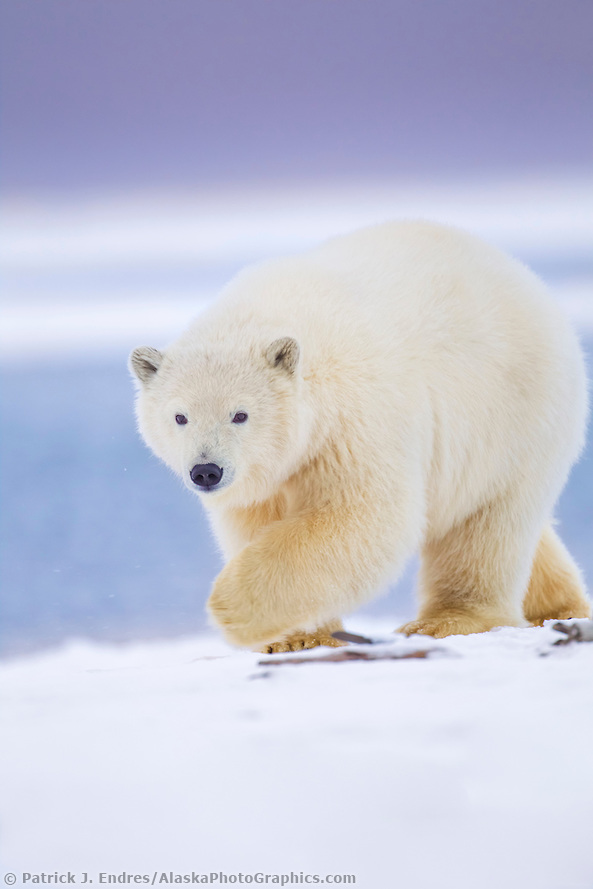
Polar bear cub walks along the snow covered shore of an island in the Beaufort Sea at dusk, Arctic National Wildlife refuge, Alaska. Canon ID Mark IV, 500mmm f/4L IS, hand-held, 1/320 sec @ f/4, ISO 800.
While it can be easily argued that most of the best photos have defined and dramatic light, the new high ISO performance of today’s digital SLR’s have produced a whole new genre of low-light images that simply could not be captured previously. Certainly not in the same quality league. In this frame of a young polar bear cub walking on the snow, of course it would have been wonderful to have a blast of sunshine, but it was mostly cloudy and getting dark (much darker than this frame actually looks). The tiny bit of sun, already set, cast a little pink alpenglow on the distant clouds, offering a very soft and gentle color palette. The camera settings here were on the margin, with motion and a 1/320 second shutter speed, ISO 800. The 1D Mark IV could have probably handled this at 1200 or 1600 ISO as well.
Stock photography buyers are not always looking for super strongly lit subjects that may take too much dominance in their design. All of that to say, it can be worth shooting, even when the light is dim.




Nice one Patrick. I’ve noticed you do quite a bit of hand-held shooting with your 500, at least relatively speaking. This one, at “only” 1/320 completely violates the 1/focal length “rule of thumb.” While I know rules are meant to be broken, care to share how you are able to get pretty sharp results (as I assume this is) hand-holding the 500 at less than “ideal” shutter speeds? I’m far less stable than I used to be, but even at my best I don’t know/think that I could achieve the results you have hand-holding a 500.
Mark,
I shoot the 500mm hand held all the time. There is a bit of a style involved, and the key is obviously to make yourself as stable as possible. This can be done by leaning on something or kneeling and architecting yourself into something of a human tripod. Then you add the image stabilization factor and you can get away with amazing results. It does sort of blow out that convention about focal length matching your shutter speed, but all conventions are overly generalized usually. It takes a little practice, but it is essential when photographing in less than perfectly calm, stable conditions. Which is often for me!
Beautiful shot of this struggling species . . .
Curious if you read about the Sacramento Bee photographer getting ‘sacked’ for an “altered” photograph . . . would love your thoughts on this.
Love this one! Nice one on getting a winner at those settings too 🙂
What a lovely photograph – soft colors. The polar bear cub has such a relaxed expression. I agree this is a winner.
Thanks Michelle and Vivian.
Great treatment of the the light. I believe I recognize that cub
Yes Bob, you likely do!