

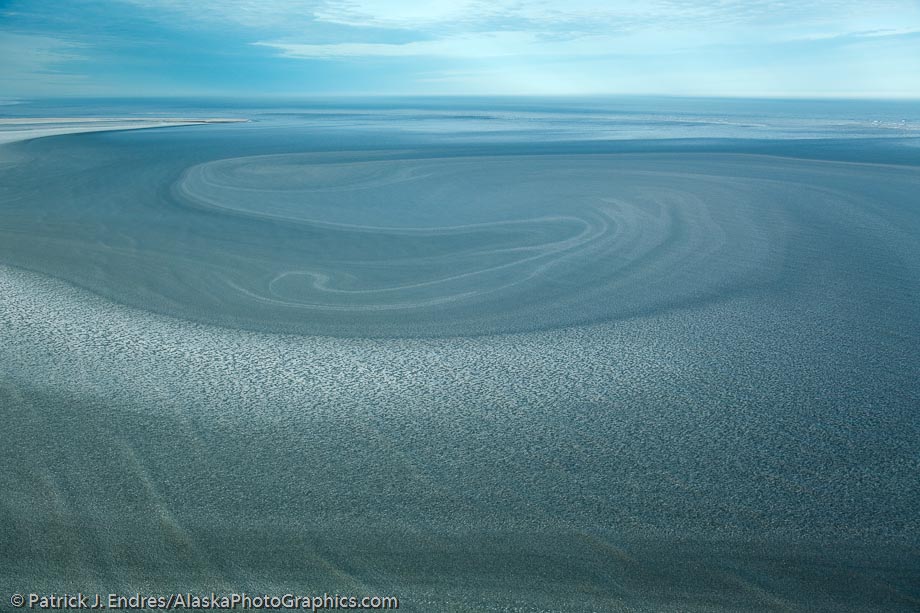
Sea ice forms on the Beaufort Sea, Alaska. Canon 1Ds Mark III, 24-105mm (28mm), 1/500 sec @ f/5.6, ISO 400
On the Arctic photo tour that I guide each year, our departure from Kaktovik, Alaska was delayed a few hours due to mechanical problems with the airplane. This resulted in a different plane showing up about three hours later. It was a Caravan, and the first time I’ve flown in one. It is a fantastic plane which seated 9 of us comfortably, but the best part was the large and clear windows. It is rare to end up in any plane with glass clear enough to shoot through. However, I was able to grab shoot a handfull of frames during the 40 minute flight to Prudhoe Bay. Given the clear day and nice weather, the pilots were amiable to fly about 1000ft for most of the journey. This photo reveals interesting current flow as the ice forms in small pancake-like circles. It won’t be long and the sea ice will be solid enough for the polar bears to trek upon.


Hello Patrick!
I am a big fan of your Alaska Photographics website, and I really enjoy reading of your travels and thoughts here in your blog. I like the abstract quality of this image – This is an interesting perspective on something I haven’t seen before.
Could you describe a little bit about how you seek out new or unique images? I enjoy outdoor photography here in Alaska, but I confess that I am in a bit of a rut and running out of ideas for “new” images. You do very well in this regard and I would be interested to hear what you think.
Jeff
Jeff,
Your question is pertinent and multifaceted, and I might add, not that easily answerable. Some of the general advice given in photo circles regarding composition is helpful, but I think that other sources of inspiration are collectively helpful for me. I too have been in ruts, and I presume most people encounter that at some point. There are few comments I could make in general, and in part I’m playing the parrot, often passing on what others have passed on to me. In particular for landscapes, I have a few simple guidelines that help move me into a scene more directly:
Try to be within a foot or two of the foreground subject/lines/shapes, etc. It’s not always possible, but the effort forces a look at what is near your feet and also what spreads out across the distance.
A sense of movement, either by motion blur or subject shape and pattern tend to invoke an emotion that makes an image stand out.
Experiment with perspective and a variety of angles
Learn about the use of split grads, either the teflon hardware or the post production simulation in lightroom, there is scarcely and image that I make that I don’t use some sort of graduated filter on. It gives control over dynamic range, light, shadow, and can help direct eye attention.
Have enough time to work with a scene. Walk away from it and then walk back to it again, look at your image and consider your positive and negative space.
And lastly, but in no comprehensive conclusion, I find that reading books helps me considerably in terms of creativity. And I don’t mean the how to photo books, I mean more generally books of various genres that keep my mind active and engaged with a creative process. It may seem hard to make a direct correlation here, but they have come to be like food in their sustenance value.
These are only a few comments, and there is a considerable amount more to say on the subject.
Patrick
Hey Patrick,
Fascinating shot.
I’m curious that you shot thru the windows – I’ve always shot thru an open window or not at all – did you not have any issue with either reflection of distortion? Generally, if I can’t open the window I don’t worry about shooting .. do you think you can keep this and your other shots from here for stock?
Thanks.
Cheers
Carl
Carl,
In general I’m in agreement with you on not shooting through a window in a plane. Whenever possible, I try to either have the door removed, or some access to an opening window. Certainly this is the case if I’m chartering the plane myself for specific aerial work. However, it is possible to take decent photos through a window. This however is a function of a number of variables. First of all, there has to be a clear portion of the window available. From there, depending on which side of the plane the light source is, you can minimize or work with limited reflection. I like to get the camera as close to, but not touching the window pane, which reduces the glare capture potential. Since those windows scratch very easy, I try to remove my UV filter since it has a ridged outer texture that if accidentally bumped against the glass, can cause a scratch. The filter-less lens is usually smooth, at least on my canon lenses. In this particular case, the window was either very new or simply very clear and I was able to grab some decent, marketable photos in respect to quality. They usually require quite a bit of contrast adjustment in “post” to remove the glass haze, but in the end, are quite acceptable. In conclusion, there in nothing like shooting from an open window or a door-less plane, but that is just not always an option.
Patrick