

I’ve spent the last two weeks photographing in the Prince William Sound region with a primary focus on the birds migrating through the area at this time of year. Eight days were spent on the MV Discovery, owned by Dean Rand of Discovery Voyages. I met Dean while working on the Exxon Valdez Oil spill and since then, have been on many voyages with him. I’m indebted to his tremendous generosity, as much of my imagery from Prince William Sound was taken during trips with him. His website is worth a visit.
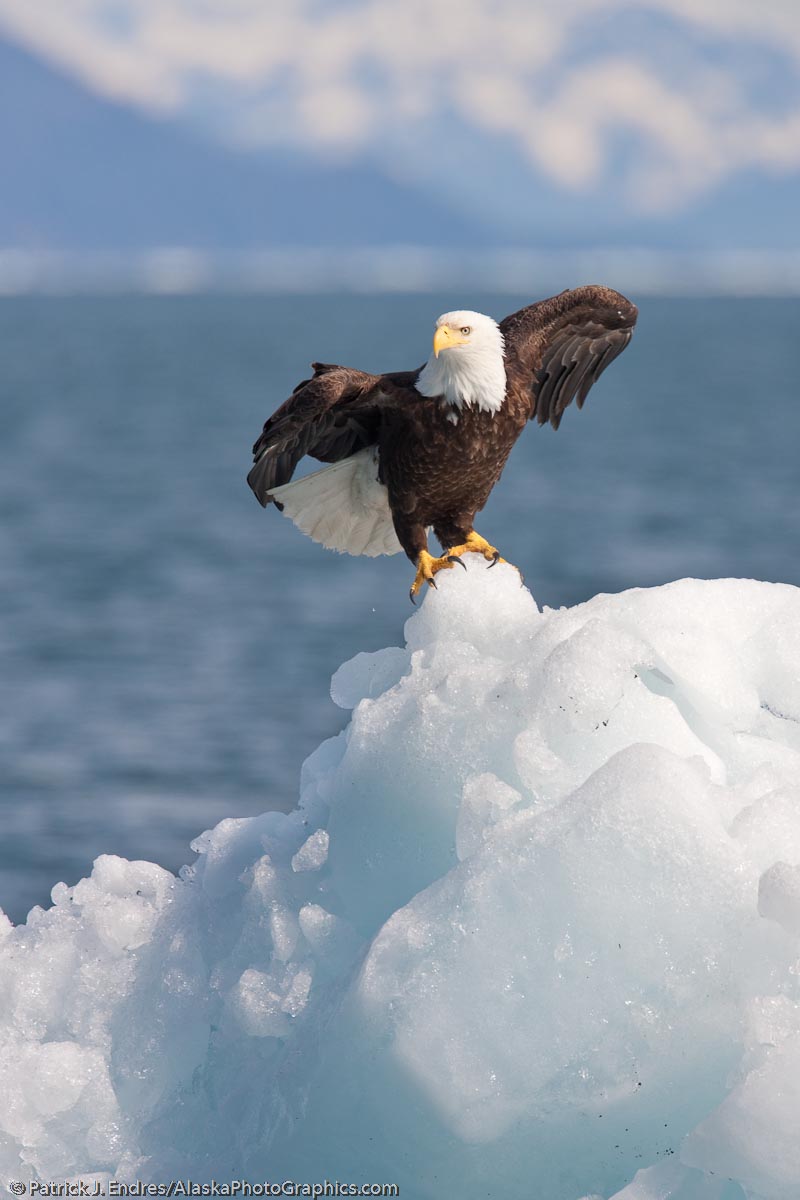
Bald eagle on a floating iceberg from Columbia glacier, Prince William Sound, Alaska. Canon 1Ds Mark III, 500 f4 IS with 1.4 (700mm) hand held, 1/800 sec @f8, ISO 200
This bald eagle was perched on a floating iceberg that calved off the Columbia glacier. The shot was taken from the bow, hand held, in AI servo auto focus mode. You are never really sure how close you can approach in these instances, so I had a lot of magnification (700mm). As we got closer, I realized that I had too much power, but did not want to risk removing my teleconverter for fears that I’d miss the lift off shot in the process. As the second image reveals, being at 500mm would have been perfect.
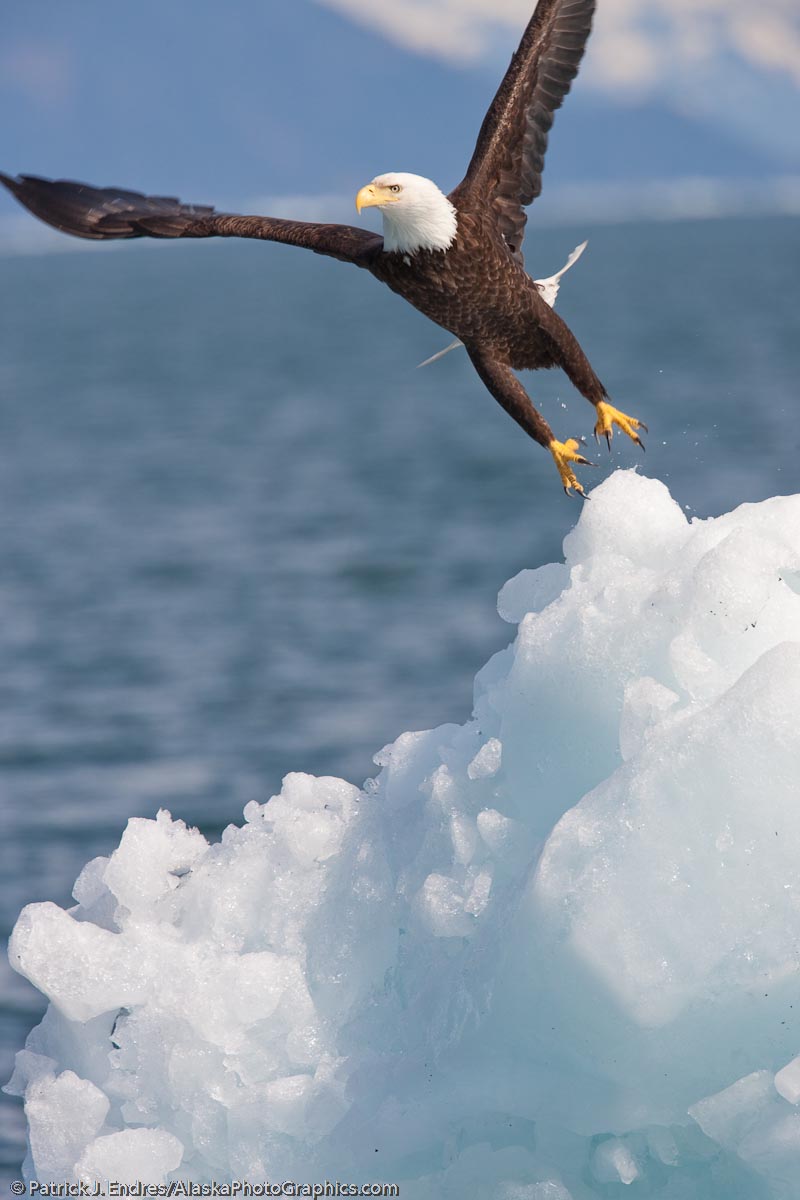
Bald eagle on a floating iceberg from Columbia glacier, Prince William Sound, Alaska. Canon 1Ds Mark III, 500 f4 IS with 1.4 (700mm) hand held, 1/800 sec @f8, ISO 200
There is a lot going in a shot like this. The boat is moving, the iceberg is moving, and the bird is moving. Hand holding a 700mm in a stable position, at least for me, makes it difficult to accurately try to manual focus–which is a challenge in its own right. So, I tried to pick a focus point that was compositionally acceptable. Tracking the bird then becomes more about auto focus accuracy than composition–the unfortunate downside of auto-focus. Additionally, the wings of a bald eagle are huge, and this becomes very apparent when it goes from a sitting position to a full wing spread. I set my exposure manually so it would not be thrown off by the bright white of the ice or darkness of the bird. Boy would I like another chance at that shot!


Another Beautiful picture as usual. I was watching a show on National Geographic called Icy Killers. The show was about the Salmon Sharks migrating to Prince William Sound and feasting on the thousands of migrating Pacific Salmon. I was wondering if you other thought about shooting there when the Sharks leap out of the water to catch the salmon. I think that would be a really cool and unique picture. I have seen a video of the shark jumping out of the water but I have not seen a photograph.
Tad,
I remember seeing salmon sharks in PWS back when I worked on the Exxon Oil Spill, but have not seen many in recent trips. It would indeed be a very interesting, but I’m sure, difficult image to capture.
Patrick
Incredible pictures…just found your site this weekend by way of your moose/wolf photos (link posted on FB by another AK photographer).
As an aspiring photographer, your images are incredibly inspirational and your workflow tips are much appreciated. I shoot a 5D 2, and haven’t saved up enough to buy a decent piece of glass yet, but hoping to get there soon!
Hailing from Prince William Sound, I had to take a gander at these images. Very powerful. You have truly captured the beauty of this area.
In regard to the salmon sharks, try Fidalgo and Gravina (just south of the Valdez arm, north of Cordova) in late-June to mid-July. Early morning, around 4 or 5, seems to be the best time. It’s a very impressive sight, and some mornings there is as many as 3 or 4 jumps at a time. Best of luck in all your photographic endeavors.
Chelsea,
Thanks and I’m happy you have found the photos and blog info helpful. At some point, I would like to photograph the Salmon sharks. I used to see them when I worked on the Exxon Valdez spill way back in 1989-90. Good luck with your photo pursuits. You picked a good camera, and don’t compromise on the glass–get the good stuff. It makes all the difference.
Thanks — I’ve got one L -series (the 17-40 f/4) and one crappy basic telephoto (70-300 f/4-5.6). I hardly even use the latter because the images are nowhere near the caliber of the ones I take with the L lens…they just don’t compare at all.